 Add to Chrome
 Add to Firefox
 Add to Edge
Meta-Programming for Linear-time Temporal Answer Set Programming
May 28, 2026
The development of temporal extensions of Answer Set Programming (ASP) has led to the emergence of non-monotonic linear-time (TEL), dynamic (DEL), and metric (MEL) temporal equilibrium logics. However, the inherent rigidity of highly optimized ASP systems often hinders the rapid exploration and implementation of alternative logical designs. In this work, we propose a flexible meta-programming framework that operationalizes the semantics of varied temporal logics through a unified, declarative framework. Our approach extends standard ASP meta-programming by augmenting clingo's theory grammar with formal type specifications and nesting capabilities. To ensure semantic correctness, we introduce a transformation pipeline that protects nested modalities from stable-model-based simplifications during grounding. We demonstrate the extensibility of our framework by implementing meta-encodings for TEL, MEL, and DEL. We provide a comprehensive account of TEL and highlight the key features for managing the interval constraints of MEL and the Fischer-Ladner closure in DEL. Finally, we introduce the metasp system, a versatile tool that encapsulates this workflow.

StreakMind: AI detection and analysis of satellite streaks in astronomical images with automated database integration
May 05, 2026Artificial satellites and space debris increasingly contaminate astronomical images, affecting scientific surveys and producing large volumes of streaked exposures. Manual inspection is no longer feasible at scale, and reliable detection and characterisation of streaks has become essential for both data-quality control and the monitoring of objects in Earth orbit. We present StreakMind, an automated pipeline designed to detect Near-Earth Objects and satellite streaks in astronomical images, characterise their geometry, and cross-identify them with known orbital objects. The system integrates all inference results into a structured database suitable for large surveys. A YOLO OBB model was trained on a hybrid dataset of 2335 images and applied to processed FITS frames. Geometric refinement, inter-frame association, satellite cross-identification, and Gaussian-based confidence scoring were then used to produce final identifications stored in a relational database. Observations from La Sagra Observatory were used to develop and test the method. On the test set, the model achieved a precision of 94 percent and a recall of 97 percent. It reliably detected faint streaks, delivered consistent geometric reconstructions, and performed robust satellite cross-identification. StreakMind demonstrates strong potential for large-scale automated analysis of linear streaks produced by both Near-Earth Objects and artificial satellites, contributing to space situational awareness.
* Published in Astronomy & Astrophysics, 708, A211 (2026), DOI: 10.1051/0004-6361/202558754
GeoRelight: Learning Joint Geometrical Relighting and Reconstruction with Flexible Multi-Modal Diffusion Transformers
Apr 22, 2026Relighting a person from a single photo is an attractive but ill-posed task, as a 2D image ambiguously entangles 3D geometry, intrinsic appearance, and illumination. Current methods either use sequential pipelines that suffer from error accumulation, or they do not explicitly leverage 3D geometry during relighting, which limits physical consistency. Since relighting and estimation of 3D geometry are mutually beneficial tasks, we propose a unified Multi-Modal Diffusion Transformer (DiT) that jointly solves for both: GeoRelight. We make this possible through two key technical contributions: isotropic NDC-Orthographic Depth (iNOD), a distortion-free 3D representation compatible with latent diffusion models; and a strategic mixed-data training method that combines synthetic and auto-labeled real data. By solving geometry and relighting jointly, GeoRelight achieves better performance than both sequential models and previous systems that ignored geometry.
Implementing Metric Temporal Answer Set Programming
Jan 28, 2026We develop a computational approach to Metric Answer Set Programming (ASP) to allow for expressing quantitative temporal constraints, like durations and deadlines. A central challenge is to maintain scalability when dealing with fine-grained timing constraints, which can significantly exacerbate ASP's grounding bottleneck. To address this issue, we leverage extensions of ASP with difference constraints, a simplified form of linear constraints, to handle time-related aspects externally. Our approach effectively decouples metric ASP from the granularity of time, resulting in a solution that is unaffected by time precision.
MHR: Momentum Human Rig
Nov 19, 2025We present MHR, a parametric human body model that combines the decoupled skeleton/shape paradigm of ATLAS with a flexible, modern rig and pose corrective system inspired by the Momentum library. Our model enables expressive, anatomically plausible human animation, supporting non-linear pose correctives, and is designed for robust integration in AR/VR and graphics pipelines.
Vision Foundation Models in Agriculture: Toward Domain-Specific Adaptation for Weed Herbicide Trials Assessment
Nov 06, 2025Herbicide field trials require accurate identification of plant species and assessment of herbicide-induced damage across diverse environments. While general-purpose vision foundation models have shown promising results in complex visual domains, their performance can be limited in agriculture, where fine-grained distinctions between species and damage types are critical. In this work, we adapt a general-purpose vision foundation model to herbicide trial characterization. Trained using a self-supervised learning approach on a large, curated agricultural dataset, the model learns rich and transferable representations optimized for herbicide trials images. Our domain-specific model significantly outperforms the best general-purpose foundation model in both species identification (F1 score improvement from 0.91 to 0.94) and damage classification (from 0.26 to 0.33). Under unseen conditions (new locations and other time), it achieves even greater gains (species identification from 0.56 to 0.66; damage classification from 0.17 to 0.27). In domain-shift scenarios, such as drone imagery, it maintains strong performance (species classification from 0.49 to 0.60). Additionally, we show that domain-specific pretraining enhances segmentation accuracy, particularly in low-annotation regimes. An annotation-efficiency analysis reveals that, under unseen conditions, the domain-specific model achieves 5.4% higher F1 score than the general-purpose model, while using 80% fewer labeled samples. These results demonstrate the generalization capabilities of domain-specific foundation models and their potential to significantly reduce manual annotation efforts, offering a scalable and automated solution for herbicide trial analysis.
From Field to Drone: Domain Drift Tolerant Automated Multi-Species and Damage Plant Semantic Segmentation for Herbicide Trials
Aug 11, 2025Field trials are vital in herbicide research and development to assess effects on crops and weeds under varied conditions. Traditionally, evaluations rely on manual visual assessments, which are time-consuming, labor-intensive, and subjective. Automating species and damage identification is challenging due to subtle visual differences, but it can greatly enhance efficiency and consistency. We present an improved segmentation model combining a general-purpose self-supervised visual model with hierarchical inference based on botanical taxonomy. Trained on a multi-year dataset (2018-2020) from Germany and Spain using digital and mobile cameras, the model was tested on digital camera data (year 2023) and drone imagery from the United States, Germany, and Spain (year 2024) to evaluate robustness under domain shift. This cross-device evaluation marks a key step in assessing generalization across platforms of the model. Our model significantly improved species identification (F1-score: 0.52 to 0.85, R-squared: 0.75 to 0.98) and damage classification (F1-score: 0.28 to 0.44, R-squared: 0.71 to 0.87) over prior methods. Under domain shift (drone images), it maintained strong performance with moderate degradation (species: F1-score 0.60, R-squared 0.80; damage: F1-score 0.41, R-squared 0.62), where earlier models failed. These results confirm the model's robustness and real-world applicability. It is now deployed in BASF's phenotyping pipeline, enabling large-scale, automated crop and weed monitoring across diverse geographies.
3DGH: 3D Head Generation with Composable Hair and Face
Jun 25, 2025We present 3DGH, an unconditional generative model for 3D human heads with composable hair and face components. Unlike previous work that entangles the modeling of hair and face, we propose to separate them using a novel data representation with template-based 3D Gaussian Splatting, in which deformable hair geometry is introduced to capture the geometric variations across different hairstyles. Based on this data representation, we design a 3D GAN-based architecture with dual generators and employ a cross-attention mechanism to model the inherent correlation between hair and face. The model is trained on synthetic renderings using carefully designed objectives to stabilize training and facilitate hair-face separation. We conduct extensive experiments to validate the design choice of 3DGH, and evaluate it both qualitatively and quantitatively by comparing with several state-of-the-art 3D GAN methods, demonstrating its effectiveness in unconditional full-head image synthesis and composable 3D hairstyle editing. More details will be available on our project page: https://c-he.github.io/projects/3dgh/.
Compiling Metric Temporal Answer Set Programming
Jun 09, 2025We develop a computational approach to Metric Answer Set Programming (ASP) to allow for expressing quantitative temporal constrains, like durations and deadlines. A central challenge is to maintain scalability when dealing with fine-grained timing constraints, which can significantly exacerbate ASP's grounding bottleneck. To address this issue, we leverage extensions of ASP with difference constraints, a simplified form of linear constraints, to handle time-related aspects externally. Our approach effectively decouples metric ASP from the granularity of time, resulting in a solution that is unaffected by time precision.
FRESA:Feedforward Reconstruction of Personalized Skinned Avatars from Few Images
Mar 24, 2025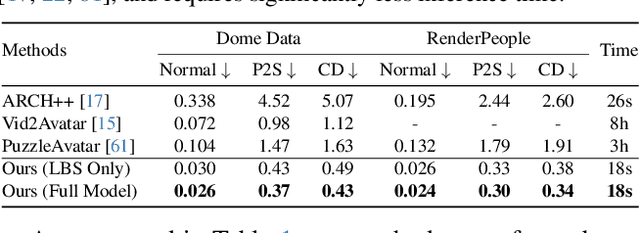
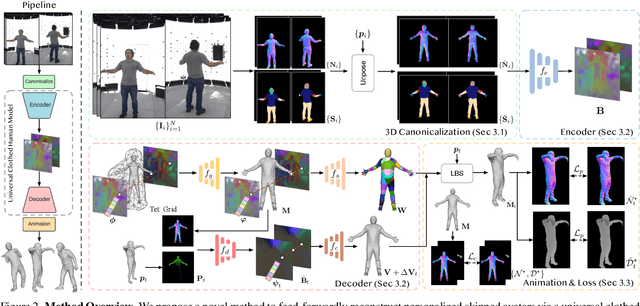
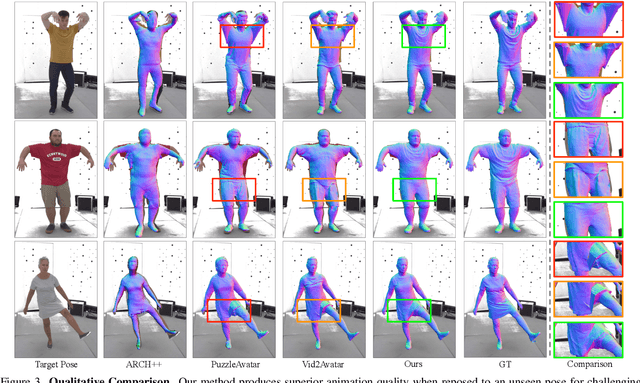
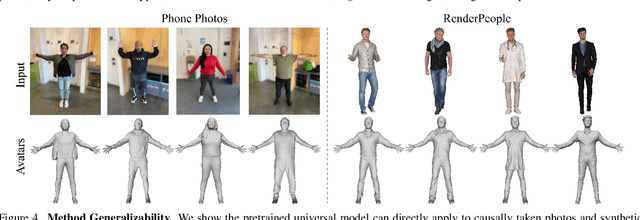
We present a novel method for reconstructing personalized 3D human avatars with realistic animation from only a few images. Due to the large variations in body shapes, poses, and cloth types, existing methods mostly require hours of per-subject optimization during inference, which limits their practical applications. In contrast, we learn a universal prior from over a thousand clothed humans to achieve instant feedforward generation and zero-shot generalization. Specifically, instead of rigging the avatar with shared skinning weights, we jointly infer personalized avatar shape, skinning weights, and pose-dependent deformations, which effectively improves overall geometric fidelity and reduces deformation artifacts. Moreover, to normalize pose variations and resolve coupled ambiguity between canonical shapes and skinning weights, we design a 3D canonicalization process to produce pixel-aligned initial conditions, which helps to reconstruct fine-grained geometric details. We then propose a multi-frame feature aggregation to robustly reduce artifacts introduced in canonicalization and fuse a plausible avatar preserving person-specific identities. Finally, we train the model in an end-to-end framework on a large-scale capture dataset, which contains diverse human subjects paired with high-quality 3D scans. Extensive experiments show that our method generates more authentic reconstruction and animation than state-of-the-arts, and can be directly generalized to inputs from casually taken phone photos. Project page and code is available at https://github.com/rongakowang/FRESA.